Beyond The Classical Spey Casts
Why Spey Casting Must Continue to EvolveBy Mark Severino
IntroductionSpey casting is often taught through a collection of established casts: the Single Spey, Double Spey, Snake Roll, Snap T, Perry Poke, and their variations. These casts form the foundation of modern Spey instruction and have earned their place through decades of practical use.Yet it is important to remember that none of these casts appeared fully formed. Every cast that is now considered traditional began as an adaptation to a fishing problem. At some point, each cast existed only as an experiment.The history of Spey casting is therefore not merely a history of preserving techniques. It is also a history of innovation.Every Named Cast Was Once an Unnamed IdeaAnglers accepted the Single Spey not because it carried a recognized title. Anglers accepted it because it worked.The same can be said for the Double Spey, Snake Roll, Snap T, Perry Poke, and countless regional variations. These casts emerged because casters encountered specific challenges involving wind, anchor placement, current speed, restricted casting space, and line control.The lesson is simple:Technique follows function.
New ideas become valuable when they solve problems.The Purpose of a CastA common mistake is to view a cast primarily as a fixed sequence of movements.In reality, every Spey cast exists to accomplish several fundamental objectives:
• Establish an effective anchor.
• Create rod load.
• Maintain tension.
• Control the casting plane.
• Deliver the fly efficiently.How you achieve these objectives may vary depending on the environment and equipment.The name of the cast is secondary.
The underlying mechanics are what matter.Environment Drives AdaptationConsider the classical Single Spey.
On a river, the caster typically lifts, sweeps, places the anchor, forms the D-loop, and delivers the cast.Current helps maintain tension and provides a relatively stable environment for placing the anchor.In the surf, conditions are different.
Wave intervals may release tension in the line, move the anchor unexpectedly, or disrupt the timing needed to form an efficient D-loop.The caster is no longer solving only a casting problem. The caster is solving a timing problem created by constantly changing water.As a result, a Surf Spey caster may first flip the line directly into the intended casting lane and begin the sweep while the repositioned line is still airborne. This allows tension to reestablish before the next wave alters the line's position.The fundamental objectives remain unchanged:
• Position the anchor.
• Establish tension.
• Load the rod.
• Deliver the fly.What has changed is how you accomplish those objectives.This distinction is important. The principles of Spey casting remain intact even as movements evolve to solve different environmental problems.New Environments Create New ProblemsMany established Spey casts evolved on rivers under conditions that demanded specific solutions.Modern Spey anglers now cast in environments far removed from those original settings:
• Surf zones
• Estuaries
• Saltwater flats
• Reservoirs
• LakesThese environments introduce challenges that traditional river casters rarely encounter:
• Breaking waves
• Long retrieves
• Moving shorelines
• Crosswinds
• Heavy saltwater fliesIt would be unreasonable to assume that every useful casting solution for these environments has already been discovered.Innovation Is Part of the TraditionSome anglers mistakenly view innovation as a departure from tradition.History suggests the opposite.The development of Spey casting has always depended upon observation, experimentation, and adaptation. The casters who created today's accepted techniques were not preserving an established system. They were expanding it.Innovation is not the enemy of tradition.Innovation is how tradition grows.Evaluating New ConceptsNew casting ideas should not be accepted merely because they are different.Neither should they be dismissed simply because they are unfamiliar.The proper questions are:• Does the concept consistently establish an effective anchor?• Does it reliably load the rod?• Does it maintain tension and control?• Does it create efficient line delivery?• Is it repeatable?• Does it solve a problem that existing casts do not solve as effectively?If the answer is yes, the concept deserves consideration regardless of whether it resembles a recognized classical cast.Practical effectiveness should remain the ultimate standard.Spey Casting Is a Living DisciplineSpey casting did not stop evolving when the classical casts were named.Modern rods are different.
Modern lines are different.
Modern fishing environments are different.The challenges facing a salmon angler on a Scottish river are not necessarily the same challenges facing a striped bass angler on an open beach or a redfish angler on a Gulf Coast shoreline.As the environment changes, so do the solutions.Some experiments will fail.Some ideas will prove unnecessary.Others may reveal useful refinements that improve efficiency, tension control, anchor placement, or line delivery under specific conditions.That process is not a break from the history of Spey casting.
It is the continuation of it.Conclusion
The great casts of Spey fishing were not created by anglers who believed all useful ideas had already been discovered.Every established cast we recognize today was once an unnamed experiment.The next useful casting concept may be one as well.Spey casting should not be viewed as a finished discipline, but as a living one. As anglers encounter new environments and new challenges, they will continue doing what Spey casters have always done:Observe. Experiment. Adapt. Improve.That is not a departure from Spey tradition.It is Spey tradition.
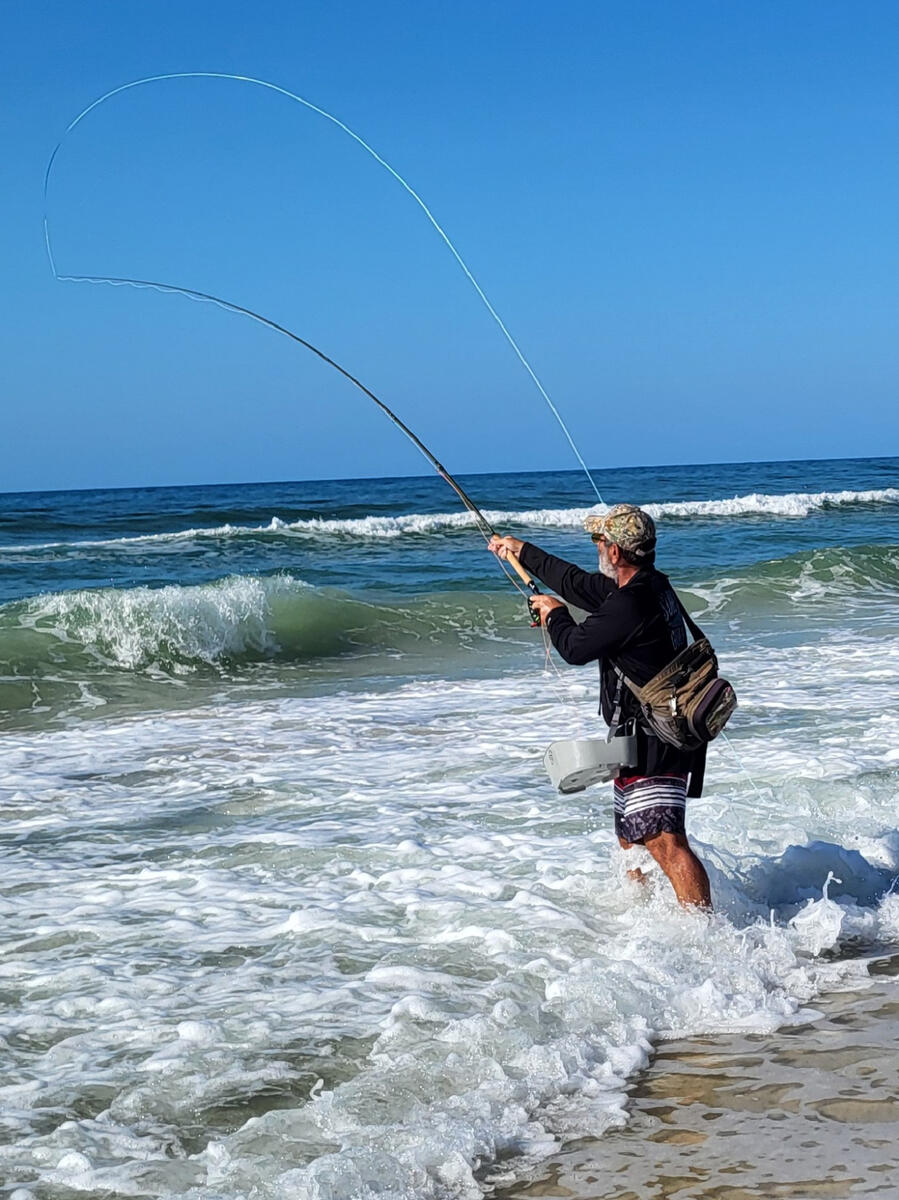
The Airborne Reset: Timing the Surf Spey CastHow to establish anchor tension and beat breaking waves when there is no river currentIntroduction
In Beyond the Classical Casts, we looked at why Spey casting must evolve when moving from steady river currents to dynamic saltwater environments.We are not reinventing Spey casting—we are extending its core principles based on the problems we face. Anchor placement, rod load, line tension, and plane control remain unchanged. What changes is how you apply them when the water refuses to cooperate.On a river, moving water grabs your line, holds your anchor, and creates natural tension for the D-loop. In active surf, moving water does the opposite. Swells lift your line, receding wash pulls slack into your system, and breaking waves can bury your anchor before you ever start your forward stroke.To cast effectively when the surf is moving, you have to solve a timing problem. Instead of letting the line settle on unpredictable water before you sweep, you execute an airborne reset.When Classic Spey Casts Still Work
To be clear, traditional Spey casts do work outside of rivers—when the water surface is stable.On glass-calm surf mornings, in protected coves, behind outer sandbars, or across still lakes and quiet estuaries, a classic Single Spey, Snap-T, or Double Spey will anchor cleanly and load the rod just fine. Without waves or surge breaking up your line tension, the water's surface tension alone is enough to hold a traditional anchor. You do not need to force an adaptation when the water is flat.The airborne reset becomes essential when wave energy, surge, and backwash disrupt the surface stability that traditional anchors depend on.Why Traditional Anchors Struggle in Active SurfWhen you execute a classical river cast, you rely on a predictable water surface to hold your anchor while you form your D-loop.In an active surf zone, three factors break that system down:
• Wave Intervals: A passing swell lifts the shooting head, instantly killing your rod load.
• Backwash: Receding water drags your sink tip toward your feet, creating slack right when you need tension.
• Heavy Saltwater Rigs: Turning over heavy Skagit heads, sink tips, and weighted flies, requires uninterrupted line speed.If your anchor sits on turbulent water too long, the surf dictates your timing instead of you.Step-by-Step: The Airborne Reset & SweepThe goal of the airborne reset is simple: establish your casting lane and start your sweep before the wave cycle steals your tension.1. Read the Wave Interval
Watch the incoming sets before you initiate the cast. Your window to load and fire is the brief pause right after a wave breaks and washes past your stripping basket, or on the clean back side of an outgoing swell.2. Define Your Anchor Lane
Visualize a straight target lane extending roughly 48 to 60 inches off your casting side. Where your fly and sink tip land in this lane determines where your forward cast will go. Align your anchor lane directly toward your target—not across your body.3. Flip Directly Into the Lane
Instead of a wide, sweeping river lift, use a crisp upward and forward flip roll to reposition the line and sink tip directly into your target lane. Keep the movement compact so you do not lose control of heavy tips in coastal crosswinds.4. Sweep While Airborne
This is the critical adjustment. Do not wait for the entire line to settle on the water.As the sink tip and fly approach the surface of your anchor lane, immediately begin your sweep into the D-loop. You achieve optimal rod-loading tension by sweeping against the combined resistance of air drag, brief water contact, and the line's mass. Because the head and sink tip are already moving and loaded with momentum, you do not need a heavy, waterlogged anchor to bend the blank—the fly kisses the surface as your D-loop reaches full extension.5. Deliver on Plane
Track your forward stroke cleanly along your chest-and-shoulder seam, staying just inside your anchor lane. Finish with a smooth, controlled stop to let heavy Skagit heads and sink tips unroll cleanly into the wind.Checking the MechanicsDoes the airborne reset meet the standards of classical Spey casting?• Anchor: Yes—it uses a brief, targeted touch-and-go anchor right at the moment of D-loop formation.• Rod Load: Yes—sweeping against air resistance, water tension, and line weight produces deep, continuous load without wave slack unloading the blank.• Plane Control: Yes—flipping/rolling directly into a defined lane keeps your D-loop and forward stroke aligned.• Repeatability: Yes—it replaces guesswork in turbulent water with a consistent, repeatable rhythm.Conclusion
We are not reinventing Spey casting—we are extending its foundational principles to solve the problems created by surf environments. Classic casts remain the right tool on lakes, quiet estuaries, and glass-calm surf, while the airborne reset gives you a reliable solution when swells and backwash take over. By adjusting when and how you engage the water, you keep control of your tension, load your rod efficiently, and turn the surf zone into a consistent casting platform.
Contact: [email protected]